I’m starting work on a nice big sample of copywriting for my portfolio. But I think this could work for a lot of creative projects – art, photography, creative writing, music, crocheting. Hell, even creating a collage out of photos of bins from other countries.
I went on a holiday once, and at all the destinations I took pics of local landmarks, including bins. Because bins from other countries looked different so I thought – why not remember these bins? Some had patterns and pictures on, so much prettier than our local slug green bins. If I was a decent artist, I’d make a collage out of the bins. My memory of making collages is from art class at school and all I achieved in those lessons was glued-up fingers.
I said the word “bins” a lot more than I intended to there. Back on topic.
The point is – if you’re reading this and thinking, “I’m not a copywriter, this isn’t for me” – it still might be! This process can work for any creative or even non-creative project.
I’m going to take you through the process of creating this piece, so that if you’re reading this, you’ve got a roadmap.
Don’t rely on Google AI summaries
For passing whims of curiosity like “why do tornadoes become so big” (I searched that yesterday), a simple Google search relying on the AI auto-answer is fine. But when you’re working on something that really matters to you, Google has its drawbacks.
- Can you really trust that AI? IBM says nope. AIs can give you misleading or downright false information.
- Relying too much on other people’s work prevents you learning stuff for yourself.
- You know what you want better than anyone (or in the age of AI) anything else possibly can.
Know what specifically you want to learn more about
Let’s say you want to write a fairly realistic story about a woman teacher in 19th century England. You’d need to learn more about 19th century England for your story to be convincing enough that people suspend their disbelief and get sucked into the plot and characters.
But you couldn’t just research 19th century England. There’s too much knowledge out there on the topic for one person to learn it all.
No. You’d need to narrow it down to something more specific like “the lives of women in the 19th century” or “teaching practices from the 1800s”.
That’s a lot more manageable. You’ll be able to get deeper into the subject. And the strangest thing is this: narrowing down your topic often gets you a wider view.
That’s because everything is connected to something else. Like the way children were taught in the 19th century shaped the lives of women in the time.
Narrowing down is better than widening up.
Question your sources
This can be like it is in school, where you’re figuring out how well your sources hold up. Are they accurate, reliable, and from authors/institutions of authority in their field? When were they written/made? Who made them? What biases are there?
That’s all important stuff to know. It affects how much faith you can have in them.
But there’s other questions you should ask your sources too. Like how relevant are they to your area of focus? Do they teach you anything new that you weren’t expecting? What other avenues of research can they lead you down? A good source should leave you with more questions than answers.
So for instance, if you’re researching women and teachers of the 19th century, maybe you find out about a specific teacher. Maybe you write your novel from her perspective.
You’re never quite the same person after doing some research that you were before. You learn something new about the world, and it changes something subtle in you. That change is what carries you forward in your project.
How to know when you’re done with research
Research is essential for you to do good work. You need to learn new things to do better things.
But it can be tempting to keep going with research, even when it’s time to stop. Learning can be addictive.
But sometimes it’s not about learning. Sometimes it’s about procrastination, or anxiety around actually taking a risk and doing the task.
You don’t want to mess up. And it’s hard to mess up research.
So you keep going. And it gets harder to stop.
The best time to stop research is when you’re at the stage where you’re thinking, “Oh, I know what to do next!” And then the momentum carries you straight into doing it.
But sometimes that stage doesn’t come.
When that happens, the best time to stop research is when you’re just going around in circles. It’s not that you know everything. It’s that the things you’re learning aren’t really changing your perspective much. Because your perspective has already been shaped and you’re ready for the task.
A deadline can really help with identifying the time to stop. Even if you don’t have an official deadline, you can create a deadline for yourself. A time-limit can be really motivating.
Think of research as taking part in a conversation
You’re finding out what other people think and then you’re figuring out what you think in response.
It’s a conversation of ideas.
Do you have any extra research tips? Feel free to share in the comments, so we can all learn together.
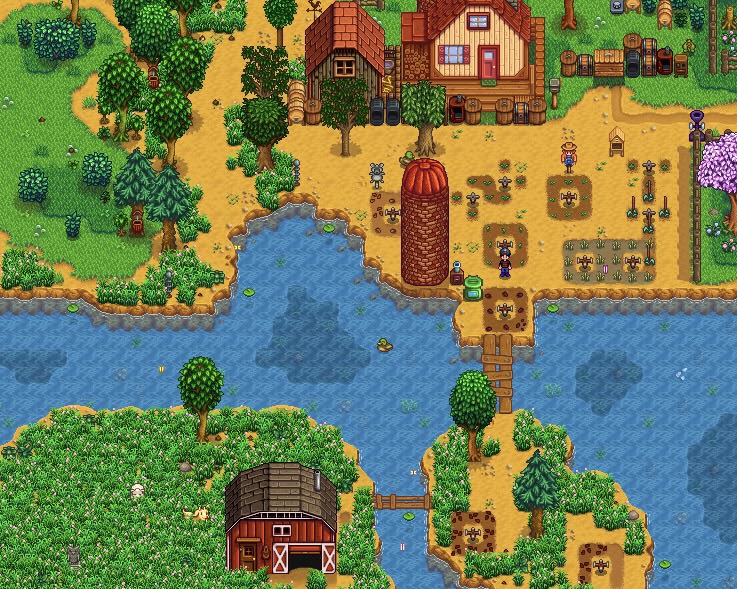
PS – I couldn’t decide what to make my featured image for this post. So I went for a screenshot of my farm from Stardew Valley because the game is cute. If you look carefully, you can see one of my in-game ducks swimming in the river. I didn’t know they could do that in the game!
 Naomi the Wordsmith
Leave a comment