
We know a bunch about why humans buy stuff and what techniques businesses use to get us to buy. You can find this info easily with a simple Google search.
But I noticed these websites often don’t have a specific example that they break down in depth. Analysing content like this really shows you what works and what doesn’t. It gives you the tools you need to do better.
So let’s break this email down into its parts and see if we can’t make it better.
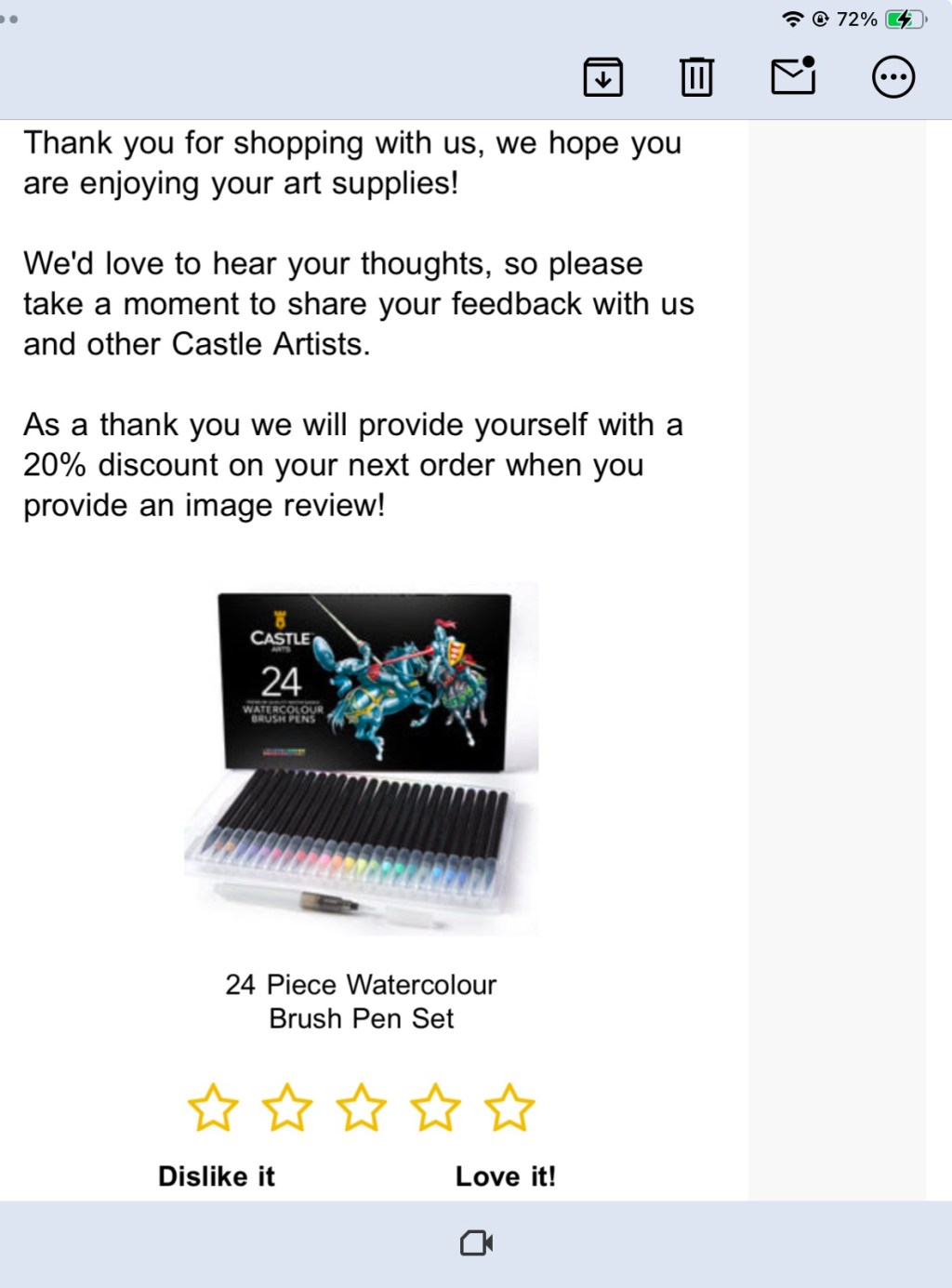
The full email
Reminder: Order CA79603-EU, how did it go?
Hello Naomi
Thank you for shopping with us, we hope you are enjoying your art supplies!
We’d love to hear your thoughts, so please take a moment to share your feedback with us and other Castle Artists.
As a thank you we will provide yourself with a 20% discount on your next order when you provide an image review!
[Then there’s a pic of the product I bought – 24 watercolour brush pens]
[And finally they prompt me to say how many stars I’d rate it]
Why it works (at least on me!) and what could be better
The subject line
Let’s start as we do when an email pops up in the inbox – check out the subject line.
Subject lines are like an email’s headline. The best headlines grab attention with a powerful hook that is impossible to resist the urge to click.
Studies show that businesses have 10 seconds or less to grab the customer’s attention or you’ve lost them forever.
It’s brutal.
Readers are unforgiving, but it’s because we’re overwhelmed with content. We only have time for what gives value to our lives.
How did Castle Arts do?
In between the good parts of their headline, there’s “Order CA79603-EU”. That’s confusing and takes me out of the message. I don’t remember the order number, I remember the pens.
So why did the headline still get my attention? Because of the words “Reminder” and “how did it go?”
This signals that there’s something to do with my purchase that I forgot to do. People are interested in themselves (I certainly am!) and don’t like forgetting things.
So I opened the email to find out what they were on about.
The personalised opening
“Hello Naomi” they say to me as I start reading. It’s nice, a little formal, sure, but flattering.
It’s warm when a business says your name instead of “Dear customer”. You feel less like a cash machine for them to draw from when they feel like it.
And they even spelled my name right.
If your customer has shared their name with you, do them the human dignity of acknowledging it. They’ll appreciate it, I promise.
The thank-you sentence
First, it’s “Thank you for shopping with us”. It’s easy to forget, but thanking people is vital.
We see everywhere, especially on our social media feeds, about the benefits of gratitude. We feel more positive.
Gratitude helps Castle Arts here by creating a reciprocal relationship. I buy their pens and now they’re thanking me for that. The cold exchange of value becomes warm and genuine.
This sense of reciprocity is key to the entire email. I’ll get to this in a few minutes.
Now for the next part of the sentence: they hope I’m “enjoying [my] art supplies!” It’s a lovely thing to wish, but it doesn’t deliver much value to the reader. What if they’re not enjoying it? That sense of disconnect can make you stop reading.
It’s better to say something about how the money helps them make good products. That shows the customer the difference they make (and hints at more value they’ll get from future purchases).
Or explain more about the process that goes into making them – that makes the pens seem even better value. The customer feels clever for buying something so good.
The Call to Action (CTA) sentence
“We’d love to hear your thoughts” and “share your feedback” makes it clear: they want me to do a review. This is great – you want your CTAs to be easy to understand, even obvious.
Then, saying “please take a moment” to do the review sets clear expectations. I know doing the review won’t take long, only a moment. It’s not one of those hideous hour-long surveys. They’re respecting my time.
As far as CTAs go, this works well. But it would work better if it was right before the actual CTA. This makes the Call to Action flow seamlessly into Action.
What makes this section so persuasive is how it builds the relationship between the reader and the writer. Between Castle Arts and its customers.
They want to hear about my experience. That makes me feel valued as a customer. It makes me like them more. And because I like them, I want to give them a positive review.
The incentive sentence
Reading on, I find out that to thank me they’ll “provide [me] with a 20% discount on [my] next order when [I] provide an image review!”
Like most people, I like a discount. And since I know it’ll only take me a moment to get it, why not do the review?
Here we get to the ultimate persuasive tactic the email uses: reciprocity.
I remember I’ve bought several products from them. First there was that box of pencils. Then I got another box of pencils. Then I got some pens and now I got some more pens.
I liked them all. And I’ve still not done a review? That’s not right. I need to return the favour.
So I do a review for them, showing the value they’ve offered for me. This helps them get more customers. Returning the favour, they give me a 20% discount.
All smiles, both sides do well out of the deal. And maybe I buy something else later.
When it comes to improving the writing, I’d go for less repetition and a friendlier tone. “Provide” signals to me a nurse giving a patient a foul tasting medicine. Discounts are a fun gift. The language should have that sense of hedonistic generosity.
The Call to Action itself
They’ve gone for the super recognisable 5 stars that you can interact with to show how happy you are. There’s nothing wrong with that – most people know what to do when they see that in an email.
Now, maybe it’s me being too much of a writer and wanting more writing. But I think a clickable CTA button like “Tell us what you think” would work well here.
Always think about the different ways you can do things. Never settle on your first idea. Choose what’s best for the situation.
And, okay, I’m really nitpicking here, but attention to detail is what good editors do. Do “I love it!” instead of “Love it!” The “I” makes the customer reading the email the hero. Though we might deny it, deep down, all of us want to be a hero in someone’s story. Let your customer be the hero in your brand’s story.
Here’s my rewritten version
Subject line: How’d you like your watercolour pens? Or maybe I’d be more creative – Make some good drawings with your watercolour pens?
[Pic of product as Castle Arts did before, to serve as a visual reminder. It’s better placed here, right under the subject line, so the visual reminder is working from the start]
Hi Naomi
Thanks for shopping with us! We’re a small business, so every purchase helps us improve and perfect the carefully-crafted tools artists like you rely on.
Your opinion matters – we want to fix what’s wrong and continue what’s great.
Take just 2 minutes to tell us what you think about your watercolour pens. We’ll give you a 20% discount on your next order as a thank-you.
Call to Action button: Share your thoughts and claim your discount
Armed with knowledge
So there we have it – we’ve discovered how an email asking for a review/survey works. To really solidify it in our memory, here’s the summary: attention, reciprocity, action.
The subject line grabbed my attention. The email engaged the reciprocal relationship between me and Castle Arts. And the call to action turned that urge to ‘pay them back’ with a nice review into action.
That’s how you turn a scroller cleaning out their inbox into someone doing a sweet review.
Breaking down this email into its working parts means we can reverse engineer it. We learn from it, we imitate it and ultimately, we outperform it.
Constant improvement.
So yeah, I was totally manipulated by Castle Arts’ excellent persuasion tactics. After all, I didn’t need the metallic pencils I got with that reward discount. But I don’t mind because of the value I got from the interaction. Those metallic pencils were pretty cool after all.
They shine when they catch the light.
That’s what the best businesses aim to do with their marketing. Capture the attention of the customers who are ready to buy and will love their purchase. Leave them with those shining memories.
Now you know how it works, here’s how to use your knowledge powers for your advantage. Only do the surveys that respect you as a customer. Your attention is too precious to waste on businesses that don’t respect your time, money, and humanity.
If you’re interested in learning more about reciprocity, check this out. If you’re based in Europe and art is more your thing, here’s the pens. Can you spot my review?
 Naomi the Wordsmith
Leave a comment